Comment by mrb
8 years ago
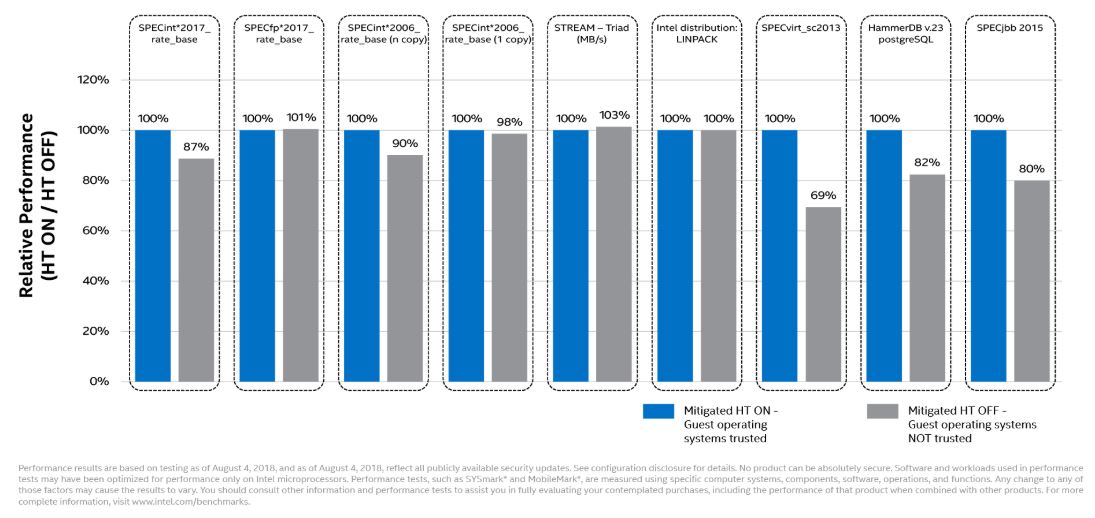
AMD claims their processors aren't affected at all by any of the 3 variants of Foreshadow (https://www.amd.com/en/corporate/security-updates) therefore SMT is safe to leave enabled. On the other hand, on Intel the only fully comprehensive workaround is to completely disable SMT, so given that disabling SMT almost halves the performance on some workloads,¹ AMD is bound to have a huge performance advantage over Intel, on these particular workloads.
¹ For example in SPECvirt_sc2013 the patch reduces performance by 31% (https://www.servethehome.com/wp-content/uploads/2018/08/Inte...) 31% is unheard of for a security patch! It's a difficult security-speed tradeoff that businesses must carefully consider.
Should truth-in-advertising laws require OEMs to stop advertising hyper-threading, e.g. 4C/8T on new hardware, if the advertised feature is not fit for purpose?
My personal opinion is "not yet".
Give intel some time to cope with this newest set of vulns, see if they can find a way to re-enable hyper threading safely, and if they can't and are still advertising hyper threading, then start going after them.