Comment by jcelerier
5 years ago
> so
there is nothing obvious in that deduction.
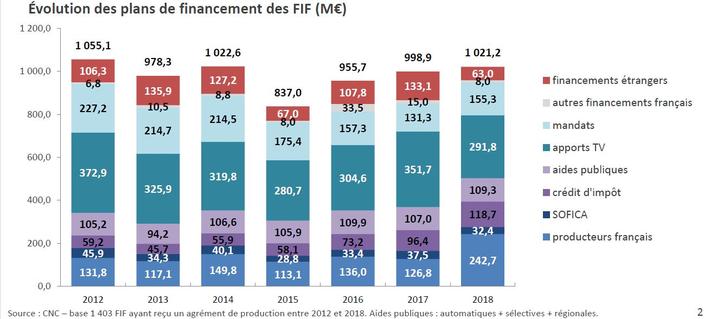
For cinema for instance a loooot of the money that serves into making movies come directly from taxpayer money - a figure I can find in the US is 1.5 billion $ of tax per year for instance in one occurence : https://www.nytimes.com/2012/12/04/us/when-hollywood-comes-t... - and let's not get started about public tv which is pretty much mostly public funds.
Likewise for my country, France - only a minority of money invested in movies comes directly from private pockets: https://i.f1g.fr/media/figaro/704x319_cropupscale/2019/03/19...
I just went off on you on your use of of the term “rights” but when you bring up the government subsidies of movies here in the States—-I agree completely. In fact, as far as I’m concerned any government subsidy at all should render the entire production public domain. I’m not being facetious.
Thank you for pointing this stuff out.
> For cinema for instance a loooot of the money that serves into making movies come directly from taxpayer money
I don't quite get your point either. Are you implying you would like ownership to be transfered from your tax money to whatever is created afterward with that money?
Would you feel entitled to ask for reports of how your neighbor spends his unemployment grant, because that's partly paid with your tax money?
> Are you implying you would like ownership to be transfered from your tax money to whatever is created afterward with that money?
I'd rather have no notion of private ownership of ideas, knowledge and cultural goods at all.
> Would you feel entitled to ask for reports of how your neighbor spends his unemployment grant, because that's partly paid with your tax money?
I don't think it's really meaningful to compare something that allows human beings to (barely) stay alive, to the benefit of for-profit corporations.
Where do you draw the line between artist making money and for-profit corporation? Does a person have the right to limit the distribution of their own work?
> there is nothing obvious in that deduction.
But it is: The concept of "private property" is pervasive and deeply ingrained in modern Western civilization. You should have very, very good ethical and practical reasons for why this should be changed.
Let me try a different angle: If you put a two-minute video of an albatross gliding through the air on Youtube, should viewers of your video also have the right to see the other five hours of your holiday footage?
You're conflating copyright and privacy. What's being discussed above is really more akin to you "If you post an albatross video on Youtube, should someone else be able to do a remix" or "should someone else be allowed to repost it in their peertube instance".
> You're conflating copyright and privacy.
No, this has nothing to do with privacy. The context was "When you buy a DVD, you don't expect hundreds of hours of unedited footage to come along with the film so you can cut together your own version." [1] jcelerier argued that consumers of a movie should have the right to receive all unpublished footage, I argued against that. In my analogy, the "buying a DVD" part is viewing the albatros-video, and the unedited, unpublished footage is the unedited, unpublished footage.
[1] https://news.ycombinator.com/item?id=25505851
4 replies →
Addendum: In the analogy, the two-minute video of the albatross is cut and edited from the rest of the holiday footage, in the same way that a released movie is cut and edited from many hours of unreleased footage.