Comment by dale_glass
4 years ago
> I would has a guess that 16ms is the physical limit for most consumer hardware (and maybe commercial computing) to detect mains loss.
Doubtful. 16ms is an awfully long time these days. There's no reason why you couldn't detect power loss much sooner, given a good input signal. The concept also gets used quite often, in the form of SSRs with zero crossing detection. Those are used for dimmers.
The reason is likely related to the awful waveforms produced by some UPSes and inverters:
https://www.christidis.info/images/blog/scope_20.png
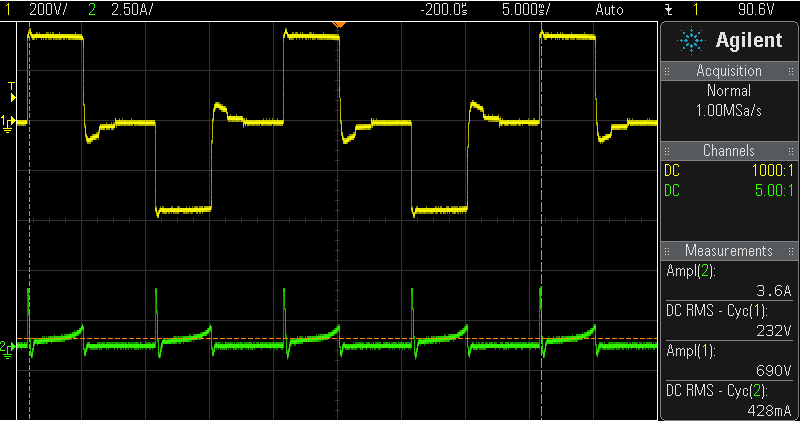
Unlike a nice sine wave, those spend a good while hovering near zero volts, so the PSU has to be able to tolerate that. Detecting loss of power sooner in this case isn't a question of cost, it's a question of that you don't have a good signal to do the detection on to start with.
> Unlike a nice sine wave, those spend a good while hovering near zero volts, so the PSU has to be able to tolerate that.
That wave chart was atrocious. I wonder if the extra load on the DC-side caps leads to them having lower life expectancy than the ones in a PSU attached to a proper power grid?