Comment by Zababa
4 years ago
> Which is consistent with my own personal observation that fans of purely functional languages tend to dislike Go, for the most part.)
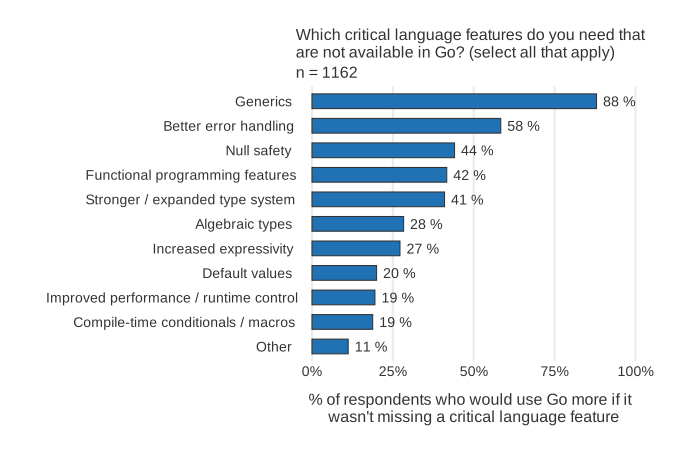
It's not only your personal observation (though I would remove the "purely" from "purely functional languages). A good indication of that: on the Go 2020 survey, the 6 most popular responses to "Which critical language features do you need that are no available in Go?" are features that functional programming languages have. All of these features are in ML and its descendants (SML, OCaml, Haskell, Scala, etc).
The graph: https://go.dev/blog/survey2020/missing_features.svg
The article: https://go.dev/blog/survey2020-results
Of the top 6 features in this chart, I see only two that are associated with functional languages: the vague "functional language features" catch-all, and ADTs. The rest is commonly found in mainstream imperative languages today.
My point is that functional languages have all these features, even if some are found in non-functional languages these days. Even functional langauges themselves are often not only functional. You can do OO in Scala, imperative and OO in OCaml. OCaml is actually a good example to talk about, as the recent developments are all about adding multicore, better concurrency and better tooling, something that Go was very good at from the start.
In a way, you can see that the people using these languages that may appear very different are converging to the same "ideal". And that's not a surprise, both languages have a very Unix-y origin, and origin in Pascal/Modula. Go added to that CSP, OCaml added ML. These days OCaml is adding things to better handle the CSP part, and some people are asking for Go to better handle the ML part.