Comment by embedding-shape
2 months ago
I remember someone talking about "last universal common ancestor" at some point, the single "origin of the cells" or something. Is that the same as the "archaeal ancestor" they're referring to here? And is the "archaeal ancestor" the same as the "Primitive archael cell" mentioned in the last image in the article? (https://www.tus.ac.jp/en/mediarelations/20251219_9539_03.png)
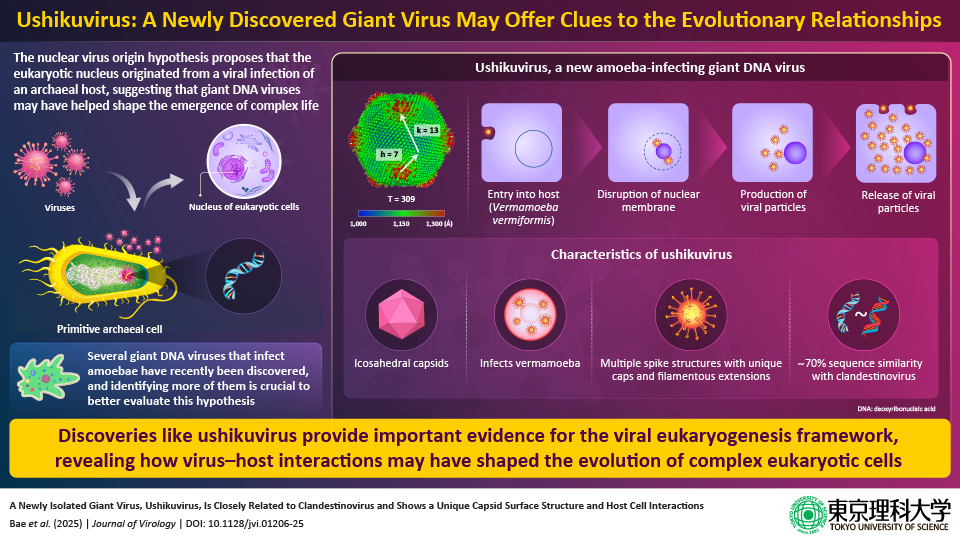
I believe "archaeal cell" is referring to an Archaea, one of the three branches of life. All three branches derive from a more distant ancestor, LUCA. LUCA was undoubtedly preceded by other ancestors, but there is (by definition) nothing else branching from them that has survived.
I anticipate the definition will become increasingly subjective as we find biology-messiness inconsistent with our concepts of ancestry.
For example, suppose horizontal gene transfer occurs from organism X to organism Y. Does that mean Y is now a branch of X?
* Does it depend on how much was transferred?
* Does it matter only if the specific sequence was passed down? If so, how much mutation is too much mutation?
* What if the same end-result occurred through a retrovirus instead of a plasmid. Is the virus an ancestor too?
* What if the swap was simultaneous and bidirectional?
* What about transitive links to organisms W, V, U that did the same?
* Are mitochondria "us" yet? If so, are we the ancestors if they redevelop enough machinery to "escape"?
etc.
The article discusses the (highly speculative) hypothesis that eukaryotes arose from a virus merging with an archaeal ancestor to form a nucleus. If the hypothesis is false (it is widely believed that eukaryotes arose from a joining of archaea and bacteria, not archaea and virii) then "an archaeal ancestor" doesn't even have a referent.
The LUCA is the common ancestor of bacteria and archaea. That would have existed far earlier, as neither of those are eukaryotes.
I'd like to take the opportunity to post this classic about the plural of virus:
https://www.ofb.net/~jlm/virus.html
More because it's funny than that it matters.
Yeah, I knew this but had a bout of brain flatus.
> it is widely believed that eukaryotes arose from a joining of archaea and bacteria, not archaea and virii
IIUC the join with the bacteria is the explanation of the mitochondria (and later chloroplast). But it does not explain the nuclei that is weird too. Is it possible something like this?
(Or swap the first two steps.)
> IIUC the join with the bacteria is the explanation of the mitochondria (and later chloroplast). But it does not explain the nuclei that is weird too.
You're right ... my mistake.
From what I know - There are two sister groups, the Archae and Bacteria. Their ancestor would be LUCA. The first Archae would be the archaeal ancestor. There should be a first bacteria to match that.
I believe that Eukaryotes then from Archae.
For now, it is still not certain whether Archaea is the sister group of all Bacteria, or only of one branch of Bacteria.
There are some very important differences between Archaea and Bacteria, in membrane composition and in the nucleic acid replication and protein synthesis mechanisms, but there are several hypotheses about how these differences could have evolved and there is not enough evidence yet to be sure which of them is true, i.e. whether the distinctive membranes, ribosomes and certain enzymes of Archaea have never been like those of Bacteria, or they have evolved from those of Bacteria.
The eukaryotes are hybrids, mainly between some Archaea and some bacteria (the ancestors of mitochondria). It is not completely certain whether the ancestor of the eukaryotes from Archaea belonged to a branch that was sister to all still existing Archaea or only of one branch of Archaea, but here the evidence makes it very likely that the ancestor of the eukaryotes belonged to an interior branch that was nested within the existing Archaea, i.e. it was sister to only one branch of the present Archaea.
In the history of life, there have been many events of hybridization between very distant living beings, so the tree of evolution is only approximately a tree, while actually being a more general directed graph. A part of these events have been the results of symbiosis, the most frequent cases being of symbiosis with some phototrophic organism able to capture solar light or with some bacteria able to consume some unusual substance from the environment.
Other such hybridization events have been with viruses, when the genes for some enzymes have been transferred permanently from viruses to their hosts and they have been retained, presumably for being better than the versions used by the hosts for the same function, previously. Even vertebrates and humans have a small fraction of their genome that originates from viruses.
Thanks for the additional detail.