Comment by user5994461
1 month ago
A view from the the debugging tools since you asked https://thehftguy.com/wp-content/uploads/2026/01/screenshot_...
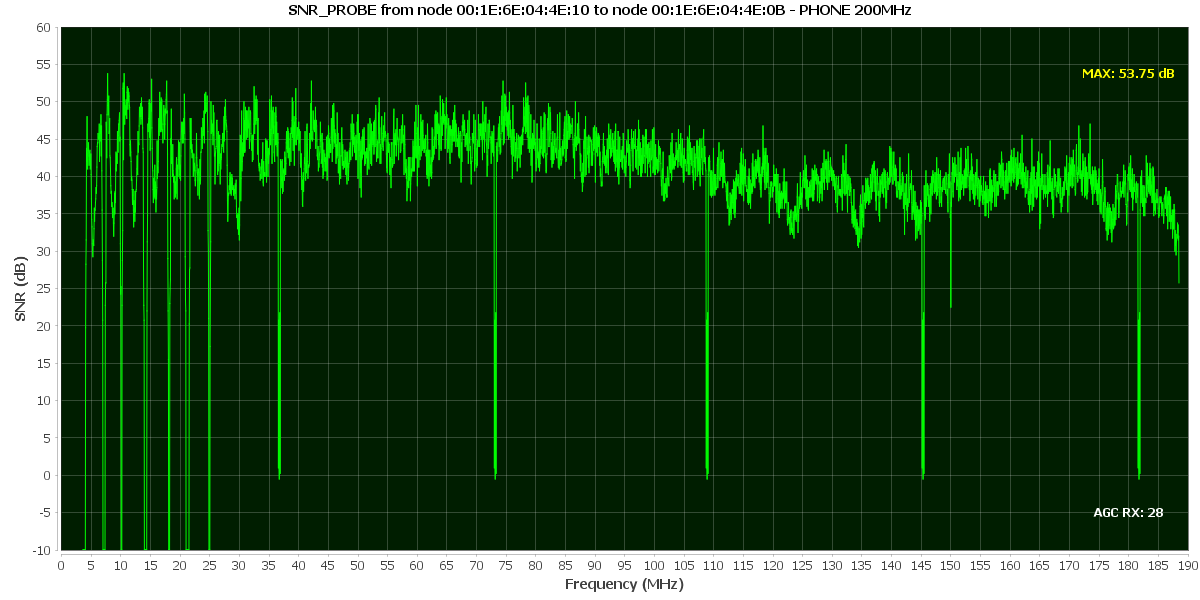
I don't think there is anything too fancy compared to a DSLAM. It's just that DSLAM are low-frequency long-range by design.
Numbers for nerds, on top of my head:
* ADSL1 is 1Mhz 8Mbps (2 kilometer)
* ADSL2 is 2Mhz 20Mbps (1 kilometer)
* VSDL1 is 15Mhz 150Mbps (less than 1 kilometer)
* Gigabit Ethernet is 100Mhz over four pairs (100 meters). It either works or it doesn't.
* The G.hn device here is up to 200 MHz. It automatically detects what can be done on the medium.
Gigabit Ethernet uses four pairs per direction. It uses the same four pairs in both directions at the same time.
1000Base-T uses two pairs per direction, actually. It's full duplex. Each port sees two TX and two RX pair.
There are four pair of wires in the cable. If you use all of them for TX, you can't receive.
> There are four pair of wires in the cable. If you use all of them for TX, you can't receive.
No, you absolutely can use them all for transmit and receive at the same time. The device at each end knows what signal it is transmitting, and can remove that from the received signal to identify what has been transmitted by the other end.
This is the magic that made 1000Base-T win out among the candidates for Gige over copper, since it required the lowest signaling frequencies and thus would run better over existing cables.
1000Base-T uses four pairs in both directions at the same time. It does this through the use of a hybrid in the PHY that subtracts what is being transmitted from what is received on the wires. 802.3ab is a fairly complicated specification with many layers of abstraction. I spent a few months studying it for a project about a decade ago.
That's not true. https://en.wikipedia.org/wiki/Gigabit_Ethernet#1000BASE%E2%8...
1 reply →
> 1000Base-T uses two pairs per direction, actually. It's full duplex. Each port sees two TX and two RX pair.
you may be thinking of 1000Base-TX (TIA‐854) which uses 2 pairs in each direction, similar to 100Base-TX (IEEE 802.3u). whereas 1000Base-T (IEEE 802.3ab) uses all 4 pairs in both directions.
basically, the -TX are dual simplex with a set of wires for each direction and -T are full-duplex with the same wires used in both directions at the same time.