Comment by logicallee
8 hours ago
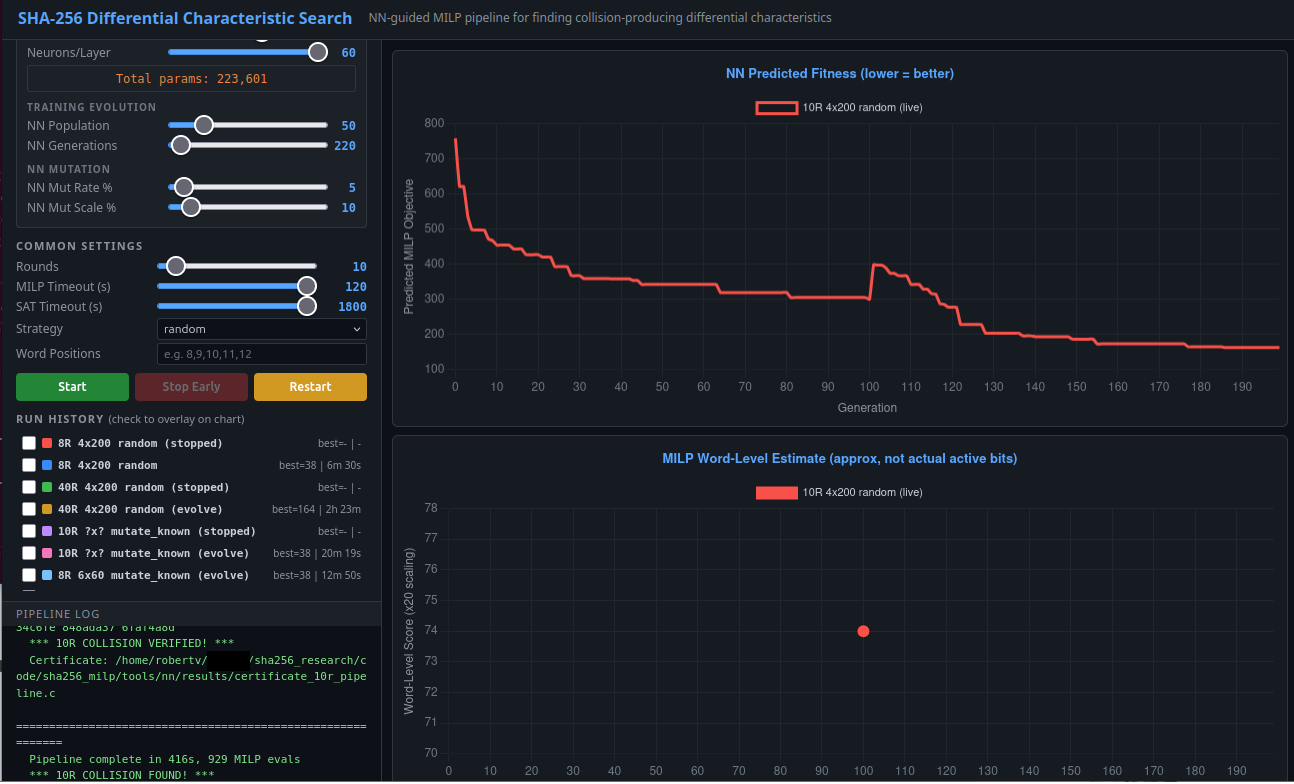
I hope they have good results and keep all the data they need, and identify all the interesting data they're looking for. I do have a cautionary tale about mini neural networks in new experiments. We recently spent a large amount of time training a mini neural network (200k parameters) to make new predictions in a very difficult domain (predicting specific trails for further round collisions in a hash function than anyone did before.) We put up a spiffy internal dashboard[1] where we could tune parameters and see how well the neural network learns the existing results. We got to r^2 of 0.85 (that is very good correlation) on the data that already existed, from other people's records and from the data we solved for previously. It showed such a nicely dropping loss function as it trained, brings tears to the eye, we were pumped to see how it performs on data it didn't see before, data that was too far out to solve for. So many parameters to tune! We thought we could beat the world record by 1 round with it (40 instead of 39 rounds), and then let the community play with it to see if they can train it even better, to predict the inputs that let us brute force 42 round collisions, or even more. We could put up a leaderboard. The possiblities were endless, all it had to do was do extrapolate some input values by one round. We'd take the rest from there with the rest of our solving instrastructure.
After training it fully, we moved on to the inference stage, trying it on the round counts we didn't have data for! It turned out ... to have zero predictive ability on data it didn't see before. This is on well-structured, sensible extrapolations for what worked at lower round counts, and what could be selected based on real algabraic correlations. This mini neural network isn't part of our pipeline now.
[1] screenshot: https://taonexus.com/publicfiles/mar2026/neural-network.png
No comments yet
Contribute on Hacker News ↗