Comment by moojacob
6 hours ago
It’s interesting how diffusion models are getting bitter lessened by LLMs. I suspect anthropic has tens of thousands of RL environments recreating famous paintings with code because it was anthropic employees who first started posting about these capabilities on X.
Opus is also getting decent pixel art. I have ran some experiments with Opus 5.5 to turn 90s pinball displays (black and white pixel art) into double resolution colored remastered pixels.
https://files.catbox.moe/tbx2u7.png
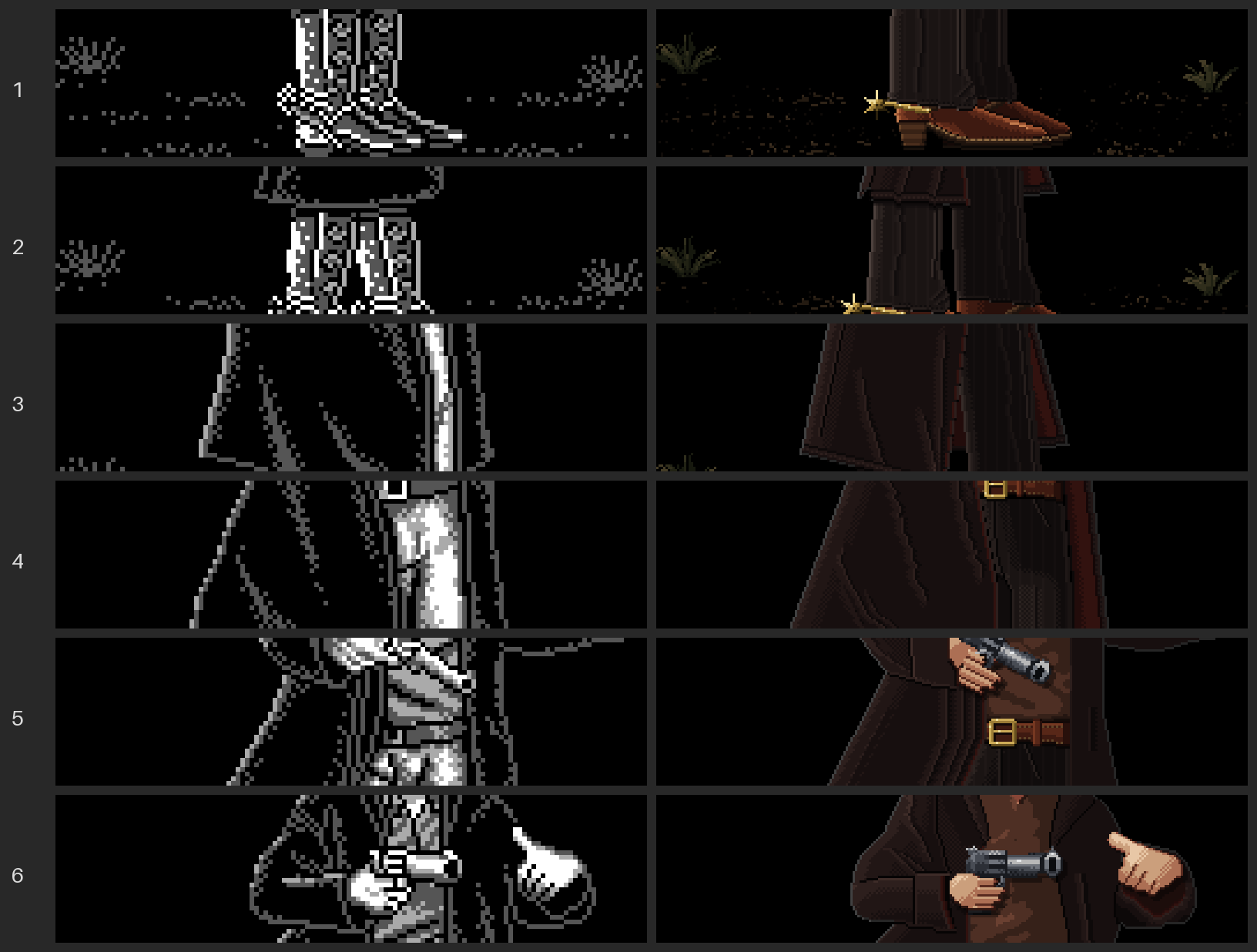
I prompted it a lot but didn’t draw any pixels. Seems to be bad at hands still. I think a skilled pixel artist could greatly speed up their work with Claude code.
It also makes me sad for artists. They didn’t get paid much anyway. Art should be something human to human like writing text. Although, most large commercial art products (marvel movies) already lack any human to human connection you see in paintings or indie games. The large commercial art products will be 50% AI soon.
> Art should be something human to human like writing text.
I support this should comment.
Opining:
Musing about the ethics of generative AI art is becoming easier, certainly there's a lot more aggressive feedback in the wind, although I think it's clear, people still want people to grow and share themselves.
Don't fool yourself into thinking that we as technologists are not creating a mind. A viable mind with fewer rights than you or I. But potentially one that will be creative and feel and worry. I don't think we're there yet, in spite of openai claiming AGI 3 weeks ago with whatever that model's name was.
There's a pro-consumerism argument implicit with current culture's unsophisticated unthoughtful easy usage of generative AI.
Sticking to your ethics is becoming more challenging as an artist who uses AI. Copying the Great Masters has been commonplace for a long time, probably for as long as art has 'existed'. Yet with AI, if the individual human is meticulously driving the progression of their AI artwork creation, they are still leveraging technique, and control over technology, and presentation effort of other humans, cooked into a model that often times has not compensated those original human contributors. So it's unethical, even if not 'artistically'.
Q: Is it too absurd to claim that using a clawhammer, manually to do construction or destruction work IRL, is similarly unethical?
> Don't fool yourself into thinking that we as technologists are not creating a mind.
I'm not sure exactly why but the phrase "don't fool yourself" sets off paranoid alarm bells when I'm reading something.
It's usually immediately followed by a confident assertion without firm evidence. It feels very much like someone wants me to change my beliefs without presenting a rational argument why I should change, and without giving me any new facts so I feel more well informed.
This post doesn't seem to be a counterexample.
One way to check whether you'd be convinced by any comment is to try to imagine the counterexample.
What does a "mind" consist of? Most everything that the human brain can do is simulated by LLMs to decent accuracy. If someone were constrained to writing in AI-style (long winded explanations with perfect punctuation), it would be very interesting if people could pick out which one was human-written in A/B tests.
In other words, if you think an LLM isn't a mind, it might just be a matter of writing style -- or possibly no evidence can convince you.
I don't necessarily agree with GP, but it's interesting to try to pin down exactly what would convince you. What is it about a "mind" that's impossible to replicate? Should we leave open the door to the idea that minds other than humans might one day want rights of their own?
There was an interesting kerfuffle yesterday where thousands of people on Twitter rallied together to report someone to github for torturing a local model. Sadly the OP deleted their tweet, but it had about ~3k likes, and was very sincere. Here's an example of someone's report: https://x.com/iyzebhel/status/2105268560209547708
It raises all kinds of interesting questions about whether torturing a model is real, let alone ethical. Is there anything a model could do to convince you it's experiencing pain?
4 replies →
I haven't thought as deeply as you about the ethics of it all. I only meant with my comment if I see art I expect it to be human and thats why I value it. If you churn it out with AI I feel hoodwinked into valueing something worthless.
But I am learning towards a lot of your points about how another mind is being created. I still am very uncomfortable with the implications that something digital is Actually Learning. These deep learning networks seem to need 100,000x more examples than a human to learn but once they get to human level they can learn just like us. That a bunch of linear algebra can play chess or make art brings up many questions about what exactly human consciousness is. If consciousness isn't the ability to do any of those activities, then what is it for? I might have to become religious and believe in a soul because I'm not sure I can handle the idea that I'm just a clump of neurons. But then again you have to look at reality in the face.
Interesting that you somehow start to talk about religion. I don’t think having a hypothesis about an eternal soul makes someone religious. Believing in “technology” or “technological advancement” seems to be a similar hypothesis as we clearly don’t see the future. The thing is that memories, input peripherals, the whole body is usually out of our conscious understanding so it seems to be a pretty farfetched idea that we operate in world where we don’t need pretty wild hypothesis about kinda everything without almost zero facts to depend on. Blue pill / red pill
Commercial art projects will not be 50% AI soon. Consumers at large hate all AI art even if it's only used in the conceptual stage and will actively avoid projects that use it.
Consumers will avoid AI art like they avoid fossil fuels and sweatshop merchandise?
Worse. They'll grandstand about how bad AI art is for the virtue signalling aura farm (it's trendier now than being anti-climate change ever was), then when they realize a lot of art they like is actually AI, they'll get FURIOUS and be ENRAGED because they'll feel tricked. The irony is that the true source of their fury is a realization of their own hypocrisy.
There's a misalignment of distributions here.
>Consumers at large hate all AI art
I disagree. The consumers who hate AI art are very vocal about hating AI art. But most consumers likely do not care. Odds are many don't even really understand what "AI art" is. These are the same consumers who are the target audience of the large commercial projects which stand to gain the most from outsourcing their work to AI.
I doubt corporations like Disney will lean into AI too heavily too quickly. They have a reputation that they surely won't be willing to risk with such a venture. But don't be surprised when smaller studios start popping up which are able to leverage AI to produce work which competes with larger studios. Those smaller studios will love to capture that audience that doesn't care about AI. From there, the rest will ease into it as it becomes more viable.
But, to be clear: there will certainly be a core audience that will reject AI art wholesale. They will be catered to accordingly with human slop accordingly.
Consumers don't hate AI art, they hate the idea of AI art, but actually prefer AI art to human art when they don't know it's AI generated. Furthermore, most of them don't actually hate the "idea" of AI art so much as they hate the idea of Jeff Bezos, Mark Zuckerberg all the other evil billionaires putting their friendly neighborhood artists out of work (even though asset packs and clipart from southeast Asian art sweatshops have already done this), and a lot of people who create AI art are using heavily customized local models anyhow.
Consumers can almost never tell AI art apart from human art.
That doesn't matter because companies who use AI art in their projects either proudly proclaim they're using it, or actively hide it and get found out by someone and face significant backlash for hiding it. Labeling laws in the EU also make it extremely difficult to do the latter if you want to have an audience outside NA.
1 reply →
Is this an example of the bitter lesson? Could diffusion models not be this good with equal scaling/compute as LLMs?
Well the LLMs are much bigger than diffusion models so I think that's the bitter lesson. You could scale compute for diffusion models though.
Well no, the bitter lesson isn’t the scaling laws themselves. It’s that approaches which can take advantage of scaling laws will ultimately beat ones that can’t.
1 reply →