Comment by gustavus
9 hours ago
So despite a borderline fanatical implementation of solar by almost every major government for 20+ years and virtually no new Nuclear plants for 30+ solar is just barely surpassing solar?
Whenever there is a discussion about nuclear I always remember this XKCD https://imgs.xkcd.com/comics/log_scale.png
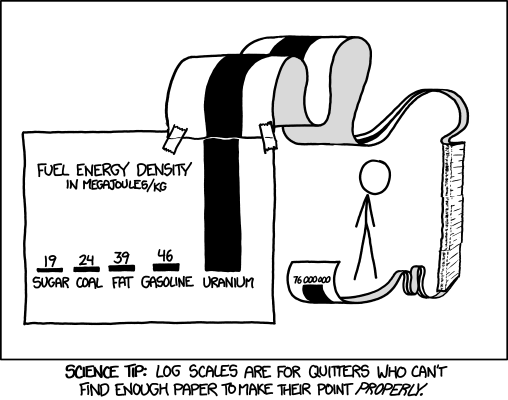
Nuclear is to solar in terms of energy generation what hydrogen is to electric for cars: it's proponents keep arguing that the other thing doesn't work and will never work, and that you absolutely, positively need their approach. And then it just works and effectively kills off the other technology within a couple of years. Nuclear is basically already dead, and anyone starting new nuclear projects now will look extremely silly in 20-30 years when they finally come online.
They might not look silly because they will have material from which to make nuclear weapons, which is the principal reason we have nuclear power at all.
I definitely would not describe implementation of solar as "fanatical" by most governments, especially 20 years ago. The growth of solar is very recent, it's beat nuclear rather quickly and it's also growing very fast. A huge portion of the world's solar infrastructure is just the last 5 years.
https://en.wikipedia.org/wiki/Growth_of_photovoltaics
> I definitely would not describe implementation of solar as "fanatical" by most governments
Idk, when you because of that implementation, for 20 years pay for the energy 10 times more comparatively to coal generated energy, that seems pretty fanatical by me.
> 10 times more comparatively to coal generated energy
Only when you completely ignore the cost of its externalities, of course.
> fanatical implementation
Not supported by the stats in TFA:
>According to the report, the gap between renewables and nuclear widened substantially in 2025. Global solar capacity increased by 510 GW to 2,383 GW, up 27% year on year,
Sounds like a quarter of the growth was in the past year.
Most of it has been installed in the last 4-5 years, and we are still accelerating.
https://ourworldindata.org/grapher/installed-solar-pv-capaci...
That’s awesome, and more evidence this hasn’t been “20 years” in the making.
World is almost at 1TW/year solar PV deployment rate. China has enough PV manufacturing capacity for double current global demand. We aren’t done going fast yet, we’re going to go faster.
We solved fusion at a distance with cheap solar and batteries. And not a moment too soon.
4 replies →
Er, yes, that's exactly the behavior you would expect of something growing exponentially - it looks slow at first and then suddenly overtakes things. 23-27% annual growth takes a while to really get moving.
I am mostly pro-nuclear, and the comic is funny, but of course we extract energy from sugar, coal, fat, and gasoline via oxidation, while we extract energy from uranium via fission. So the more relevant variable being demonstrated in the comic is chemical process vs nuclear process, not how much energy is "in" the fuel. And that comparison is a lot less cut-and-dry.
Good luck getting fission to work on any of the other materials.
Well, what would you expect a solar rollout to look like?
Assuming we'd instantly switch from zero solar demand to unlimited solar demand, we'd need some kind of scaleup of PV manufacturing first, and with a fixed construction capacity of PV factories we'd see a linear rise in PV factory capacity - which would result in an exponential growth in yearly PV factory output.
But the same applies to the factories as well: the construction capacity is going to scale up as well, so as more PV factory part manufacturing becomes available we'll start to see an exponential growth in new PV factories, which would result in even larger PV factory output.
Scaling from "lab experiment and niche application" to "significant chunk of the grid" is a lot harder than scaling from "significant chunk of the grid" to "the entire grid" - especially with solar being embarrassingly parallel rather than requiring mega-scale deployments.
The first TW of solar capacity took 60 years to reach. The 2nd TW took 2 years. We've reached the inflection point.
China is building a lot of nuclear, and in my home province in Canada they are planning to expand nuclear infrastructure (we will see if it comes to pass).
Solar just thrives in places without dependable established grids and has way lower buy in.
Two different tools for different things.
It really is sad how ugly solar is. Miles and miles of beautiful, peaceful open desert are ruined. It's a bit of an environmental travesty.
You're aren't looking at all factors here. I look at solar and think its beautiful for what its displacing.
Utility scale solar PV restores deserts. It also compliments agriculture use cases (“agrivoltaics”).
If you believe solar is ugly and deserts are beautiful, well, “beauty is in the eye of the beholder.” I believe clean, solid state hardware that will reliably produce low carbon energy for decades without causing any harm and potentially contributing positive benefits to its surroundings, with no other inputs required, is incredibly beautiful. Like simplicity, it is the ultimate sophistication (da Vinci).
The Great Solar Wall: China doubles down on its ambitious effort to tame deserts - https://www.scmp.com/news/china/science/article/3363108/grea...
Triple win: solar farms in deserts can boost power, incomes and ecosystems - https://www.nature.com/articles/d41586-024-00516-8
Swathes of Earth are turning into desert — but the degradation can be stopped - https://www.nature.com/articles/d41586-023-03621-2
https://en.wikipedia.org/wiki/Agrivoltaics