Comment by rl3
3 years ago
I'm just here to post old 3dfx commercials:
https://www.youtube.com/watch?v=ooLO2xeyJZA
https://www.youtube.com/watch?v=JIOYoZGoXsw
https://www.youtube.com/watch?v=43qp2TUNEFY
The print ads were similarly incredible:
http://www.x86-secret.com/pics/divers/v56k/histo/1999/commer...
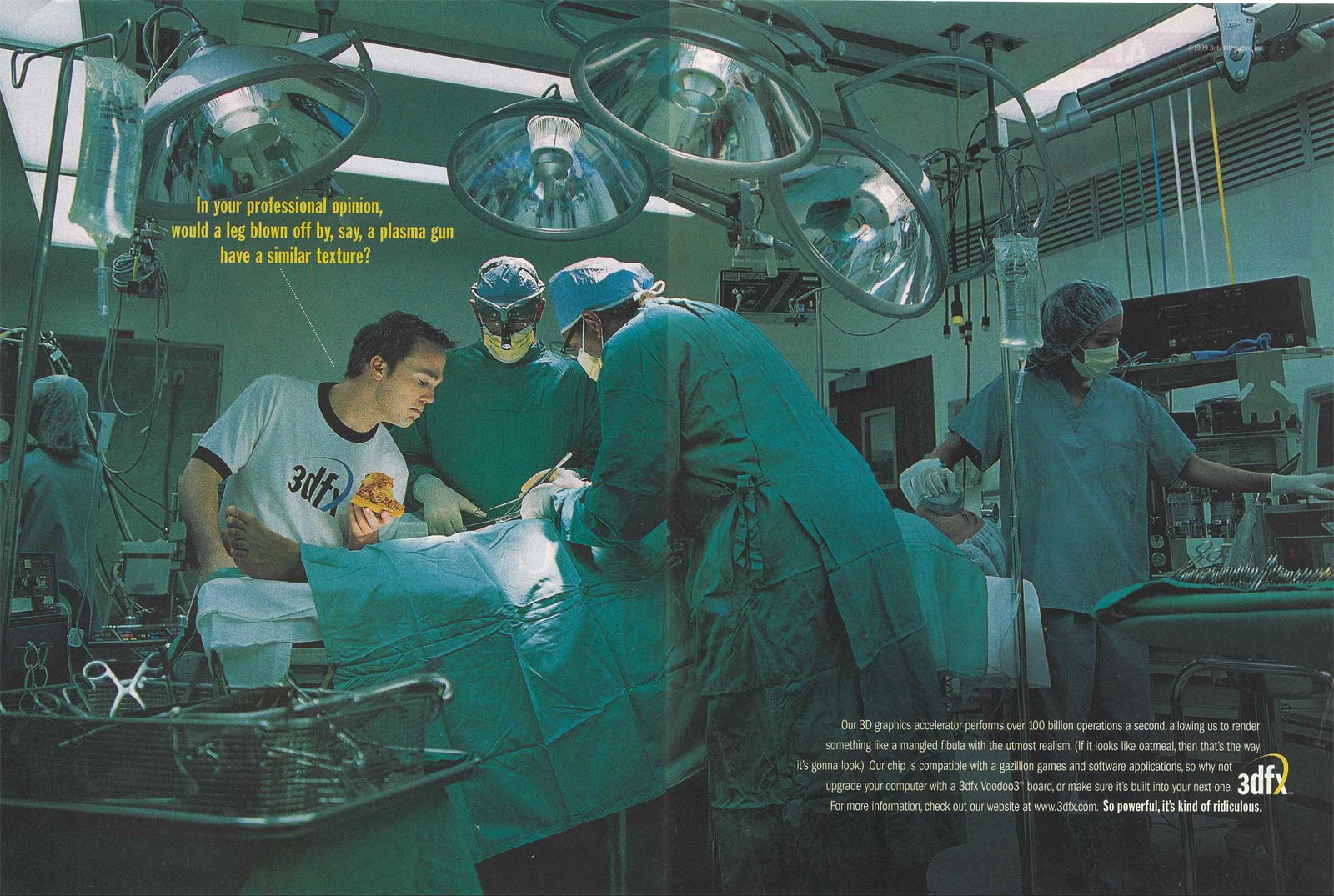
https://www.purepc.pl/files/Image/artykul_zdjecia/2012/3DFX_...

https://fcdn.me/813/97f/3d-pc-accelerators-blow-dryer-ee8eb6...

Most of the upvotes to the original post seem to nostalgic reactions to 3dfx just based on the title.
Because the article is kinda hard to follow for the uninitiated. Heavy name and jargon dropping haha
100% if you didn't experience the delta between software rendered and 3dfx hardware accelerated live as it unfolded 3dfx does not tell you anything.
I liked the first advert. The world hunger one though really rubbed me the wrong way.
Well, I think it was taking a swipe at a particular brand of insincere feel-good corporate bullshit marketing that was fairly prevalent at the time. Faceless conglomerates trying to manage their image such that they appeared to be benevolent world citizens—not ruthless plunderers.
That is opposed to say, today's brand of insincere feel-good corporate bullshit marketing.
They were making fun of greenwashing. Fun still does have its place in personal development, say most guides to the current climate catastrophe for human beings.
But right now, I too wish we would have a more liveable planet instead of perfect entertainment in polluting, air-conditioned cities. But I studied the wrong topic for me to actually thrive in the former, and not the latter environment.
100 billion operations per second, what are we at now, 100 trillion?
We are in the 4 Petaflops on a single card age currently, my friend: https://resources.nvidia.com/en-us-tensor-core/nvidia-tensor...
It is quite insane. Now, getting to use all of them is difficult, but certainly possible with some clever planning. Hopefully as the tech matures we'll see higher and higher utilization rates (I think we're moving as fast as we were in the 90's in some ways, but some parts of how big the industry is hides the absolutely insane rate of progress. Also, scale, I suppose).
I remember George Hotz nearly falling out of his chair for example at a project that was running some deep learning computations at 50% peak GPU efficiency (i.e. used flops vs possible flops) (locally, one GPU, with some other interesting constraints). I hadn't personally realized how hard that is apparently to hit, for some things, though I guess it makes sense as there are few efficient applications that _also_ use every single available computing unit on a GPU.
And FP8 should be very usable too in the right circumstances. I myself am very much looking forward to using it at some point in the future once proper support gets released for it. :)))) :3 :3 :3 :))))
> We are in the 4 Petaflops on a single card age currently
FP8 is really only useful for machine learning, which is why it is stuck inside tensor cores. FP8 is not useful for graphics, even FP16 is hard to use for anything general. I’d say 100 Tflops is more accurate as a summary without needing qualification. Calling it “4 petaflops” without saying FP8 in the same sentence could be pretty misleading, I think you should say “4 FP8 Petaflops”.
4 replies →
what is the usual range of flop utilization (10-30%?) and is there a resource for learning more about the contributing factors?
2 replies →