Comment by Herring
20 days ago
Since the end of WW2, Democratic administrations have presided over significantly higher job growth than Republican administrations.
https://arc-anglerfish-washpost-prod-washpost.s3.amazonaws.c...
20 days ago
Since the end of WW2, Democratic administrations have presided over significantly higher job growth than Republican administrations.
https://arc-anglerfish-washpost-prod-washpost.s3.amazonaws.c...
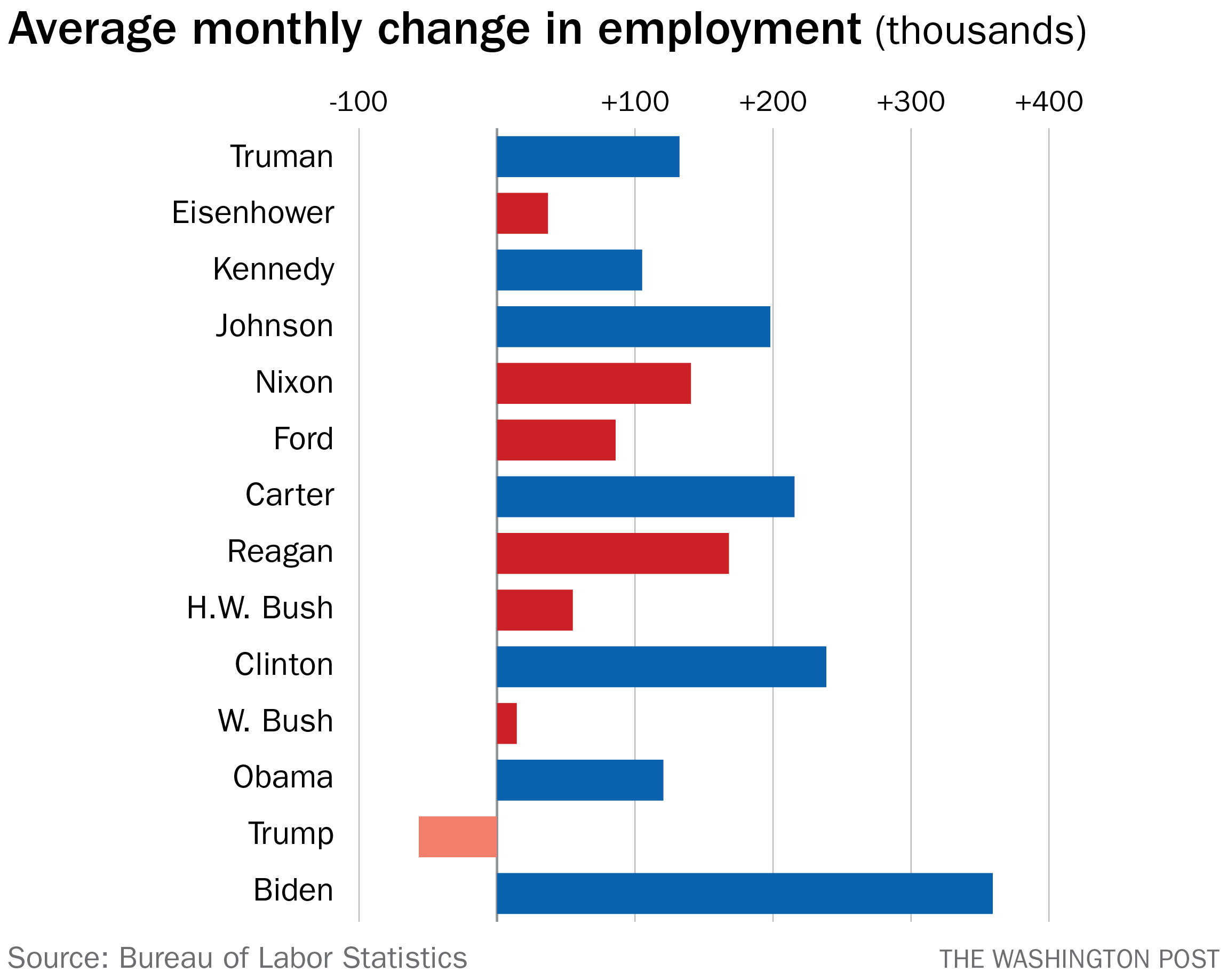
It's even crazier when you look at the data since the end of the cold war in 1989. Then the ratio of jobs created is 50:1 for democrats.
Financial looting is not good for the labor market. Who could guess.
How am I supposed to consolidate my power if the market doesn't crash so I can purchase residential and commercial real estate at bargain prices? Every third restaurant and business on Las Olas was shuttered in 2009, the buildings sold for next to nothing. Today there's one after another—Ferrari, Bugatti, Lamborghini, Porsche, Bentley, Maserati—parked on the street in front of those same buildings, all the while, Steve B. and I enjoy that Luigi's coal fired pizza! /s
Yeah, they call this "accumulation by dispossession" and it's been a mainstay of neoliberal economics since it's inception roughly ~50 years ago:
https://en.wikipedia.org/wiki/Accumulation_by_dispossession
Don't know why you're downvoted, that such possibilities are allowed in a completely made up system that can be changed at any time to better society, and not just ~10,000 people across the world, is a gross indictment of the current system.
All neoliberalism has done is made us more alienated, privatized the public commons, destroyed the environment, and hasten income inequality to levels that were worse than the gilded age.
If something doesn't change soon... we'll you can use your imagination to fill in the blanks.
3 replies →
I'll see if I can dig it up, but I remember reading that on average, under democratic presidencies going back to FDR, the economy in general performs better than it does under a republican presidency. If I'm remembering right, it's not as simple as mere ideological differences because there has been changes within the parties in those intervening ~75 years but the trend still holds.
Found your article for you, as I was looking it up the other day:
https://en.wikipedia.org/wiki/U.S._economic_performance_by_p...
thanks!
There are many marginally employable swing voters who vote Republican when they have jobs and the Democrats in charge ask for taxes, then vote Democratic when they get put out of work and need a social safety net.
This is largely the crux of it.
GOP is the fun dad party and Dems are the mommy party.
Republicans run economy hot until it blows, then Dems get voted in to clean up. People get annoyed about taxes and regulation when economy is ok again, fun dad promises ice cream and pizza for dinner forever.. rinse & repeat.
Wrong. What's also in the data is that Ds also create the most economic growth. Sorry. Rs just believe in things that are not true, as evidenced by the current admins wacky tariff theories that are disproved in Econ 101.
3 replies →
Carter has good employment, but terrible inflation making everyone poor in miserable. His Fed appointee, Paul Volcker raises interest rates, kills inflation, puts the country in recession, and drives unemployment up during Reagan's first years in office. Carter's job numbers look better than they should, and Reagan's worse, unless you look at the bigger picture.
Carter gave up the presidency to save America then. Volcker did the right thing.
He does deserve some credit, but 1979 was a total mess for the growth, inflation, the dollar. Nominating a credible Fed chair to fight inflation was both a risk and politically expedient in the short term. Trying to build some economic credibility at the risk those policies slowing growth.
Reagan supported those interest rate changes. Reagan than continued to push deficit spending well after the recovery from those first couple years, a huge lasting trend in Republican administrations ever since.
It's also very hard to assume that Reagan being elected in 76 would've avoided the oil-driven inflation at the end of that decade.
But of course, we've decided as a country/media to generally blame Biden for non-policy factors that put the economy on a wild bullwhip ride from 2020-to-2023ish, soooooo... maybe Reagan can deal with getting the blame for the inflation too!
The bigger picture being that this is political nonsense. We all know Reganomics.
They did not pay their bill for their own agenda then, and they have still not paid their bill for trillions in follow-on expenses.
They cut taxes and debt-financed war, which forced the US further into debt.
2 replies →
I don't think presidents have all that much to do with the economy (vs. the legislature). Well... maybe the most recent example is to the contrary with certain actions that historically should have been the role of Congress.
That's true. Though in this case the administration is taking a much more active hand in the economy than any in almost a century.
For the most part the correlation between administrations and the economy is arbitrary. But in this case I would make a case that it is causative.
It's not usually quite as causative as this administration, but it's also not arbitrary. Even leaving aside the president's party correlating with the majority party in congress (at least until the midterms) the policies of the cabinet picks can have pretty significant effects.
Sort of. I've done a lot of thinking about this one, and realize that it's really not just "one person" but a very large team of individuals, along with the "politics" of everything. If the President brings on a good staff, makes solid cabinet appointments, and they themself being a singular large part of the legislative process in modern years--given that it's usually fairly difficult to get 2/3rds of Congress to agree on anything--you can see the President actually has significantly more influence than you'd think.
In addition, it's the circles that person runs in and the circles that person's people run in. Do you think judge or cabinet appointments are decided on by one person? Sure, the President is a figurehead in this position and ultimately has to say yes or no, but there's a large pool of candidates out there and it's up to the staffers, maybe friends, maybe people in the know to propose those people to the President.
So while on paper the President doesn't, or shouldn't have that much power--in actuality with our current political process it's certainly much more.
Now, that said, just like the billionaires--they can only control so much. At least in the United States, there are competing interests even among the wealthy class, and sometimes shit just sort of happens--like a meteor killing the dinosaurs....or the release of decades of e-mails, videos, documents, and communications surrounding their pedophile behavior on a secret island in the Caribbean.
I disagree, but my personal belief is the economy and the government stewardship thereof work much the same way as WH40K ork technology
If that were true then why would there be such a glaringly clear example that presidential party influences economic performance?
Mostly coincidence. There aren't that many data points. There are under a dozen Presidents in the last half century. Too small to attribute significance.
I do believe that there could be a small causative effect, but there is usually a very long delay between cause and effect.
5 replies →
I looked this up. "10 of the 11 recessions between 1953 and 2020 began under Republican administrations”. It seems Republican = Recession.
It seems silly to blame these on the president though, consider just the past two recessions and how little they had to do with the actions of POTUS...
They are still responsible for making the recession easier or harder or longer
The Tarifs and the way trump acts, for example, massively disrupts markets.
1 reply →
I mean egg prices went up because of avian flu and that was Biden's to own so seem perfectly reasonable.
2 replies →
Ok, but is it cause or effect? Maybe Republicans do well when there is fear about the economy and a recession is coming.
Depends. If it's a Republican president in office, we must look at many factors, it's a difficult thing, y'see, many variables and such, market fluctuations, etc. etc. etc.
If it's a Dem president in office? 100% the Dem's fault.
15 replies →
Surely some of that is lag time in economic policy.
The fact that consecutive Republican administrations in this graph fared even worse suggests that is not the case.
I’d have called Reagan very conservative, am I missing something?
2 replies →
Let's not omit the fact that Covid hit in Trump's last year in 2020, where he had a booming economy and lowest unemployment late historically amongst minorities.
2 replies →
> Surely some of that is lag time in economic policy
Why? What if constantly launching foreign wars, leveraging up the financial system and running up deficits isn’t sound economic policy?
Wasn't trying to be political, just making an observation that 4 years is probably too short of a time to credit policy changes within a single administration.
7 replies →
WW2 really got the US economy going, so maybe the issue it a lack of scale in the warring?
Is it possible that can be attributed to lagging effects of their predecessors’ policies?
The consecutive GOP events don't seem to point to that.
Congress has a substantially greater impact on the business climate than the President.
And the president has enormous influence over what congress does (veto).
Of course everything is nuanced; the trend is merely interesting especially juxtaposed against people consistently voting for republicans for "economic" reasons.
That’s unless you have a Congress that lets the President usurp the pose of the purse that should be theirs and Supreme Court that rubber stamps everything he does
If you are referring to the current administration, SCOTUS has barely "rubber stamped" any of his actions, and has rejected several already (though we will see with tariffs... but Polymarket has it only 31% in favor of the president so at least the odds are in our favor).
1 reply →
And Congress is controlled by the president as overriding a veto is extremely difficult.
This president will also veto your congressional seat if you cross him. See what happened to the people who voted to impeach him, they got primaried out.
Where does threatening allies, tariffs and kidnapping foreign leaders fit into this?
He creates uncertainty and it’s hard to see how that helps the US economy.
I'm not so sure either have much impact. Economic policy doesn't change much between administrations and Congress has been ineffective for a long time. Politics is mostly culture war things these days.
The Fed seems to be the big driver of the economy. Other than that, the government is moving things at the margins. Even Trumps tariff shenanigans don't seem to have rocked the boat much.
> Politics is mostly culture war things these days.
“These days” like, since Eisenhower, or are we just posting absurdist nonsense as apologia? Economic policy doesn’t change much? Ok.
Except they have abdicated most responsibility, especially when the president is of the same party, for decades.
Many now talk like they work for the president.
CES establishment payroll survey monthly change averages is quite the choice of stats lol.
JOLTS is where stress shows first. Openings fall,[1] hiring slows,[2] quits drop,[3] and layoffs rise later.[4] Biden in particular shows the weakness of your provided stats.
[1] https://fred.stlouisfed.org/series/JTSJOL
[2] https://fred.stlouisfed.org/series/JTSHIL
[3] https://fred.stlouisfed.org/series/JTSQUL
[4] https://fred.stlouisfed.org/series/JTSLDL
Thanks for providing actual data and contributing to the discussion instead of the knee-jerk responses in the rest of the replies here.
The charts paint a much more precise picture on what is happening, and I actually don't see anything that strongly support it being a partisan effect.
Maybe read the top comment and examine the graph.
The biggest change to me the acceptability of falsehoods on the left. It is a battle they will not win.
>CES establishment payroll survey monthly change averages is quite the choice of stats lol.
Can you explain why? Given that it's presumably averaged over the president's entire term, doesn't that provide a good measure of how much jobs were added under a given administration?
It's a lagging indicator meant to credit or discredit administrations for past administrations' actions, handpicked to obfuscate cycle capture. CES is backward-looking by definition, so it is being abused here.
Also think of average populations under constant growth, as under Obama and Trump I pre-COVID: Trump's average would be higher in absolute terms than Obama, despite no fundamental change, and Biden higher still, and Trump II higher yet. Absolute populations and jobs go hand in hand. Averages without normalization are statistical theater.
Us Wikipedians have done a poor job on the federal statistical system (FSS or NSS), and this one of many results, this HN thread. I am working on it with the help of chat bots, but progress is slow given my focus on US healthcare and welfare systems. Fundamental laws have been documented, but the actual systems they enable are poorly documented.
I've always heard market forces and policies dont take effect until the following presidency.
The top comment has a graph. If you ignore single term presidents, the pattern remains the same.
That seems like sarcasm because it is an overused excuse that republicans give for the bad usa economies under republican presidents.
I never once heard a reasonable explanation why policies only start to have an effect at the end of a year that is divisible by 4 or 8. It makes no sense if you think it through.
It's the ratcheting mechanism of bipartisanship.
One party develops, the other party cracks down on potential economic wins for the working class.
Both parties make sure the capitalist class stay in power.
>S&P 100 added more than 300,000 jobs — 94% went to people of color.
Democratic administrations also engage in and promote discriminatory hiring policies which flagrantly violate the civil rights act (Title VII specifically).
https://www.bloomberg.com/graphics/2023-black-lives-matter-e...
Based on that link, I don’t think I want the jobs that were created.
It would also pay to keep in mind that the link claims that the preceding layoffs hit the same group. Ie, they were the ones there to be hired after losing their jobs.
It also says that people of colour are underrepresented in the job market (in the companies measured in your link) when compared to their overall makeup of the population.
Correcting that would take some years of imbalance in hiring.
It often takes years to show the effect of one administration’s policies? How do we know that Eisenhower’s policies didn’t “help” Kennedy job market ? Or that Obama’s policies didn’t “hurt” Trump job market? Picking two examples
This graph is too simple as there were also other macroeconomic situations at the time but this is interesting enough that I’d like to see a long article that expands on this one graph with other data
Is there a line chart or a stacked area chart of this over time?
This seems to confirm that Joe Biden created the most jobs of any president in recent modern history.
Joe Biden "created" jobs the way covid "created" job vacancies. Maybe time periods with worldwide upheaval should be taken with a little salt.
That doesn't make sense. Could you explain what you mean?
Here we're looking for a change in the slope of that job creation line
2 replies →
Joe Biden also presided over the largest America that ever existed, and took power at a moment when a huge rebound in jobs was inevitable.
So you haven't disagreed that Joe Biden is the greatest job creating president ever?
You've just helped explain that job creation was necessary due to the disaster performance of his predecessors.
4 replies →
There has to be some lag, and it is more about who controls Congress.
For example, the housing crisis and bubble were largely driven by legislation passed years earlier, including the 1999 repeal of Glass Steagall under Clinton. That was passed by a Republican controlled Congress, and the crisis eventually exploded under Bush. So I do not think either Clinton or Bush can be directly blamed for the housing crash. It is the repeal of the glass steagall act.
And was the dot com bubble crash in early 2000s caused by Clinton or by Bush? Or some legalization passed a long time ago? Or it just a business cycle?
More broadly, I would argue that presidents, and even legislators, have limited control over the actual health of the economy. Are we going to say Trump is responsible for the AI boom? And if this AI boom collapses into a massive bubble burst under the next administration, will that president be blamed instead?
The 2008 housing crisis would have played out exactly the same if Glass-Steagall had still been in effect. The big banks that failed--Bear Stearns, Lehman Brothers, Merrill Lynch--were all pure investment banks. The same applied to Goldman Sachs and Morgan Stanley, back then. And most of the small banks that failed were pure commercial banks.
The whole mortgage-backed security and collateralized debt obligation show would also have been legal under Glass-Steagall and had been common practice for years by the time of the repeal. The same with NINJA and 0% down-payment loans.
Or Covid when roughly 22 million jobs were lost in March and April 2020 alone
[flagged]
Macro-economic policy is political. I'm sorry.
Are you serious arguing that managing the economy isn’t political?
Grow up. The world is political whether you like it or not. Elections and apathy both have real consequences.
It apparently does when one major party is full of destructionists who have had much success in politicizing everything, including a lot of what used to just be basic core American values.
[flagged]
3 replies →
Job loss is not political?
Someone is in a financial position to absorb the fallout, huh?
Good for you.
For now….
the idea that the US economy is apolitical is, itself, ideological. and that ideology is called neoliberalism
[flagged]
Which is really neither here nor there.
Anyone implicated by the Epstein files should go to jail. That can remain true while also not being relevant to a discussion of which party's economic policy has historically performed better.
[dead]
I mean, part of this is just math. If a government spends more, it’s literally injecting money into the economy, so of course you get more jobs and growth in the short term. That spending is the jobs. If you tighten spending to cut waste or rebalance the books, growth slows and jobs shrink, but that’s kind of the tradeoff when you’re trying to fix long-term issues.
Over the last few decades, neither party has really cared about deficits anyway. Everyone’s been spending, just at different speeds. The real question isn’t “who creates more jobs,” it’s whether the spending is efficient, sustainable, and actually creates long-term value. Eventually the bills come due, interest costs rise, and priorities shift from growth to just keeping the lights on.
So yeah, Democrats tend to show stronger job numbers, but spending more will almost always do that. Whether it’s good spending is a separate debate. Budget discipline isn’t partisan, it’s just basic economics.
> I mean, part of this is just math. If a government spends more, it’s literally injecting money into the economy, so of course you get more jobs and growth in the short term.
Thats not necessarily true. During Bill Clinton's presidency he cut the deficits and the debt and yet the economy saw very strong job growth.
https://www.factcheck.org/2008/02/the-budget-and-deficit-und...
https://en.wikipedia.org/wiki/Jobs_created_during_U.S._presi...
And Clinton (mostly Gore as VP) cut the federal civilian workforce by about 20%, while following the both the letter and spirit of the law, and not causing chaos.
I’m not sure how true this is given that both Clinton and Obama cut the deficits and in Obama’s case he did it despite complaints from the left.
Democratic administrations see less spending growth, though. Definitely not more. Look it up.
You're confusing rhetoric with policy.
Fair enough, I didn't dig too deep though here's what I have come up with - I'm sure there are many factors, but it is quite interesting here:
Historically, Democratic and Republican administrations have followed distinct fiscal and economic patterns: Democrats typically oversee deficit reduction and falling unemployment, often achieved by maintaining or increasing the tax burden. Conversely, Republicans typically oversee deficit growth and rising unemployment, largely driven by decreased tax burdens through legislative cuts. Statistically, since 1945, real GDP has grown faster under Democrats (4.3% vs. 2.5%), while modern Democratic presidents (Clinton, Obama, Biden) have all reduced the deficits they inherited, whereas every modern Republican (Reagan through Trump) left office with a larger deficit than when they started
So you'd think tax cuts would create more jobs, less unemployment but it has not. It seems like the opposite, I'm sure there is much more to it.
2 replies →
If you think republicans lowered spending I have a bridge to sell. See two Santas strategy.
Yea, you can create programs that create jobs, by spending taxes. So this should be zero surprise.
The question you should /really/ be asking, since taxes are involved, is, was that hiring actually effective? Did we create jobs that actually provided lasting value to the world? Or did we just juice the numbers for the polls?
Nothing happened in 2020 to affect this chart I'm sure. I would expect nothing less from the publication that falsely claimed Russians hacked into the US energy grid before an election.
9/11, 2008, and now AI job displacement is also bad luck
Many publications have made that claim about a Russian hack. Is it inaccurate?
Ok, but there were also 36+ months prior to covid in Trump's first presidency...
Correct. The unemployment rate was 4.7% in January 2017 and was 3.6% in January 2020. Or if we look at total private sector employment that went from 123,300,000 to 129,300,000 (its highest ever, at the time). That's an average of 125,000 jobs per month, or equivalent to Obama (although Obama's unemployment was significantly higher for both terms).
[dead]