Comment by Strilanc
6 hours ago
> That graph suggests that even with the best error correction in the graph, it is impossible to factor RSA-4 with less then 10^4 qubits. Which seems very odd.
It's because the plot is assuming the use of error correction even for the smallest cases. Error correction has minimum quantity and quality bars that you must clear in order for it to work at all, and most of the cost of breaking RSA4 is just clearing those bars. (You happen to be able to do RSA4 without error correction, as was done in 2001 [0], but it's kind of irrelevant because you need error correction to scale so results without it are on the wrong trendline. That's even more true for the annealing stuff Scott mentioned, which has absolutely no chance of scaling.)
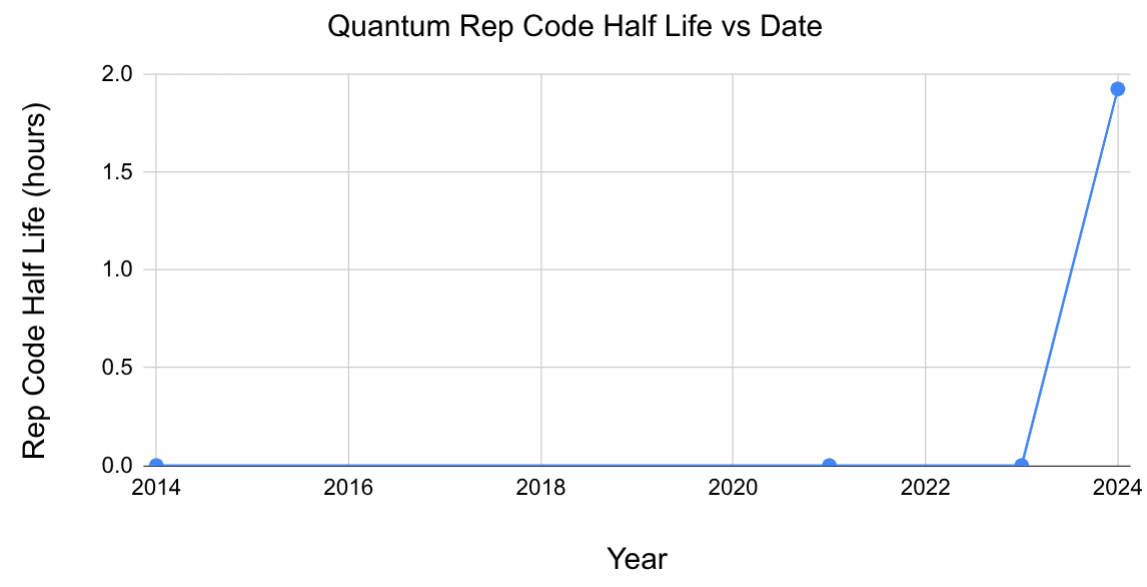
You say you don't see the uranium piling up. Okay. Consider the historically reported lifetimes of classical bits stored using repetition codes on the UCSB->Google machines [1]. In 2014 the stored bit lived less than a second. In 2015 it lived less than a second. 2016? Less than a second. 2017? 2018? 2019? 2020? 2021? 2022? Yeah, less than a second. And this may not surprise you but yes, in 2023, it also lived less than a second. Then, in 2024... kaboom! It's living for hours [4].
You don't see the decreasing gate error rates [2]? The increasing capabilities [3]? The ever larger error correcting code demonstrations [4]? The front-loaded costs and exponential returns inherent to fault tolerance? TFA is absolutely correct: the time to start transitioning to PQC is now.
[0]: https://www.nature.com/articles/414883a
[1]: https://algassert.com/assets/2025-12-24-qec-foom/plot-half-l... (from https://algassert.com/post/2503 )
[2]: https://arxiv.org/abs/2510.17286
No comments yet
Contribute on Hacker News ↗